
The Garden Is Watching the Critics Now
Madison Square Garden’s facial recognition controversy has always sounded like a niche New York fight, something for Knicks fans, lawyers, privacy groups, and people who read the fine print on venue signs. That framing is too small.
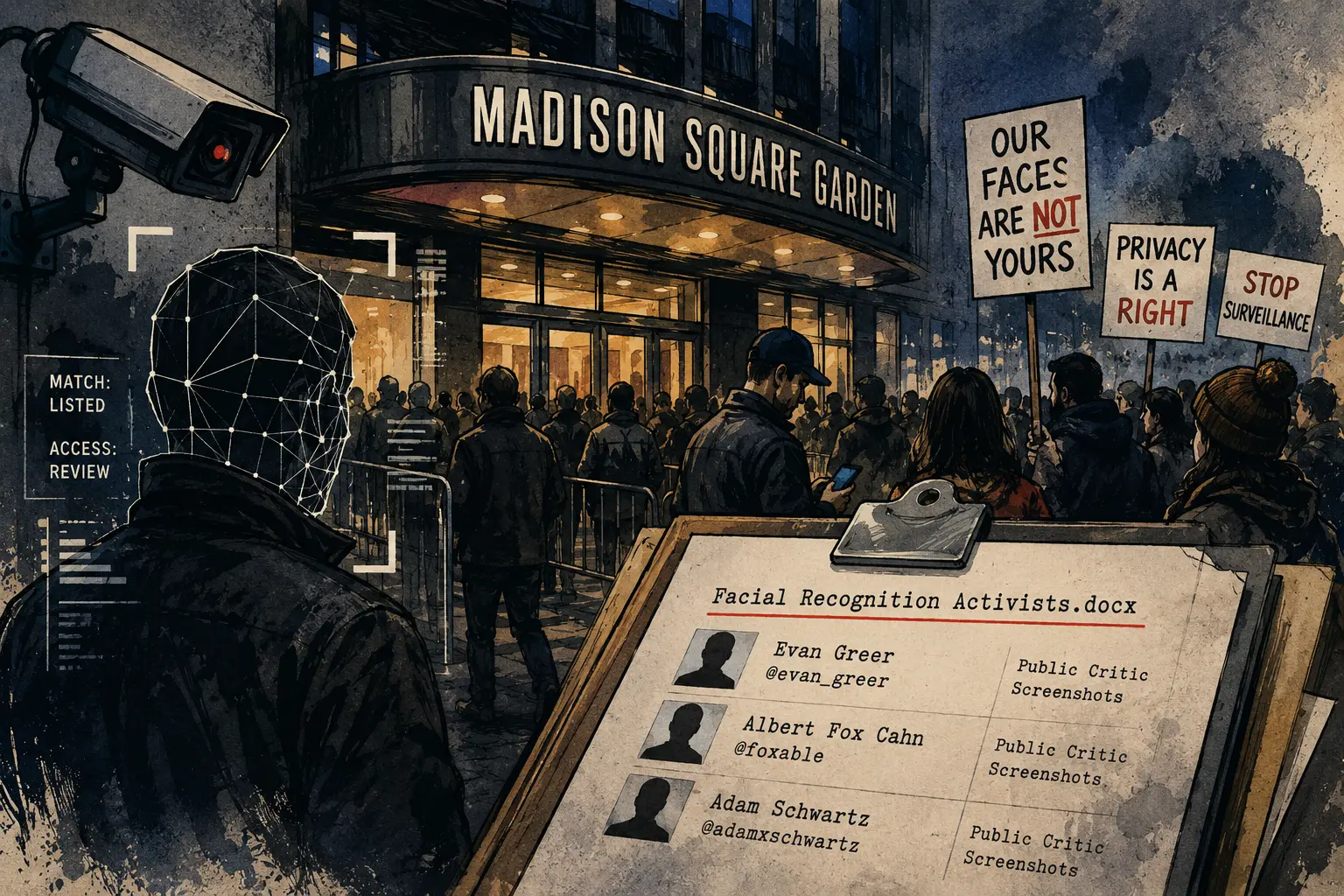
The new claim reported by 404 Media is sharper: MSG allegedly kept a document on activists who publicly criticized its facial recognition program. That takes the conversation beyond “Can a venue scan faces for security?” and into a more uncomfortable question: what happens when a powerful private venue can identify critics, track criticism, and decide who belongs inside?
This is not just about one arena. It is about whether public-facing businesses can build private surveillance systems with public-life consequences.
What This MSG Surveillance Fight Is Really About
- The Garden Is Watching the Critics Now
- The Quick Read
- Why the Dossier Story Hits Different
- The Security Argument Is Not Enough Anymore
- A Better Rule for Biometric Venues
- The Bottom Line
- FAQ
- References
The Quick Read
- Core issue: MSG facial recognition is controversial because it appears to be tied not only to venue safety, but also to exclusion, criticism, and reputation control.
- What changed: 404 Media reported on June 23, 2026, that a document titled “Facial Recognition Activists.docx” listed three privacy critics and collected their comments, handles, and related background.
- Why people are mad: A surveillance system used at the door can become a pressure tool when the same company tracks critics outside the ticket line.
- What defenders will say: Private venues need tools to manage threats, litigation risk, disruptive patrons, and crowd safety.
- Bottom line: Security technology needs strict limits when it is used by a business that also controls who gets to participate in major cultural events.
Why the Dossier Story Hits Different
The normal defense of facial recognition at a large arena is simple: big crowds create real security concerns. A venue hosting concerts, playoff games, celebrities, and high-profile public figures has a responsibility to keep people safe. That part is not fake.
But the dossier story changes the emotional and political center of the debate. According to 404 Media, the document listed activists who criticized MSG’s facial recognition program, including Evan Greer of Fight for the Future, Albert Fox Cahn of the Surveillance Technology Oversight Project, and Adam Schwartz of the Electronic Frontier Foundation. It reportedly included social handles, comments, and screenshots of public criticism.
That may not sound dramatic at first. Companies track media mentions. PR teams monitor critics. Security teams review public threats. The problem is the combination. A public-facing company with a biometric screening system is not just “monitoring the conversation” when it also has the power to identify faces at entrances and deny access to events.
That is the controversy. The speech record and the face scanner sit too close together.
The usual myth
- “If you did nothing wrong, you have nothing to worry about.”
- “It is private property, so the company can do whatever it wants.”
- “Critics are exaggerating because facial recognition is just another security camera.”
Those lines sound neat until you imagine the same model spreading. A concert venue tracks critics. A grocery chain flags suspected troublemakers. A mall keeps a list of people who complained online. A stadium quietly builds a profile of protest organizers. The technology does not need to be perfect to change behavior. It only needs to be intimidating enough.
What the record suggests
MSG has already faced years of criticism over facial recognition. In 2023, New York Attorney General Letitia James raised concerns about the company’s policy after reports that lawyers connected to firms in litigation with MSG were barred from venues. Elected officials and privacy advocates also called on MSG Entertainment to stop using facial recognition on fans, arguing that it could chill speech and punish perceived adversaries.
MSG has defended its policies in past reporting, saying it was excluding a small percentage of lawyers during active litigation and rejecting claims that its policy was unlawful or discriminatory. That defense matters. A controversial policy is not automatically illegal just because people hate it.
But legality is not the same as legitimacy. A company can be within the law and still create a rotten civic norm.
The Security Argument Is Not Enough Anymore
The most generous version of MSG’s position is that venue operators need discretion. Nobody wants unsafe arenas. Nobody wants staff forced to handle preventable threats with outdated tools. If someone has been violent, stalked performers, threatened staff, or caused serious security issues, a venue should have a way to respond.
The hard question is where “security” ends.
A system built to stop credible threats should not become a velvet-rope blacklist for critics, lawyers, protesters, or embarrassing customers. That is where facial recognition becomes different from a bag check or a metal detector. A bag check looks for an object. A face scan identifies a person, connects them to a file, and can follow them across venues and dates.
The FTC’s 2023 Rite Aid case shows why this matters beyond MSG. The agency said Rite Aid failed to use reasonable procedures in its facial recognition surveillance program, and the settlement barred the company from using facial recognition for surveillance purposes for five years. That was a retail case, not an arena case, but the lesson travels: when face surveillance creates real-world exclusion, humiliation, or bias risk, “we meant well” is not good enough.
Mini case example: the lawyer ban problem
The lawyer-ban controversy is the cleanest example because it shows how wide the net can get. A person could be excluded because of where they worked, even if they were not personally involved in a case against MSG. ABC News reported in 2023 that attorney Kelly Conlon was barred from a Radio City Music Hall event while accompanying her daughter’s Girl Scout troop because her firm was in litigation with an MSG-related entity.
Supporters may call that corporate self-protection. Critics call it retaliation by infrastructure. Both sides know the same fact: facial recognition made the policy easier to enforce.
That is the whole issue. Once a face becomes a ticket condition, ordinary life starts to feel permission-based.
A Better Rule for Biometric Venues
There is a middle ground between “ban every camera” and “let billion-dollar venue operators build private watchlists with vibes-based oversight.”
A serious biometric policy should have at least five limits:
- Purpose limit: Use facial recognition only for specific safety threats, not general criticism, litigation pressure, or brand embarrassment.
- Written rules: Publish a plain-language policy that explains who can be flagged, why, for how long, and how decisions are reviewed.
- Appeal process: Give wrongly flagged people a real way to challenge the decision before a family outing or paid event is ruined at the door.
- Retention limits: Delete biometric templates and related records when the safety reason expires.
- Independent audit: Require regular testing for accuracy, bias, access control, and misuse.
This is not anti-security. It is adult supervision for a technology that can quietly turn a venue into a checkpoint.
What not to do
Do not reduce this story to “MSG bad” and stop thinking. That is too easy, and it misses the bigger warning.
The better question is whether the same playbook could become normal in other places. If a famous arena can use facial recognition and internal tracking with limited public visibility, why wouldn’t airports, campuses, stores, hotels, festivals, and office towers push the same boundary?
Once the public gets used to face-based exclusion, the debate becomes harder to reverse.
The Privacy Test Every Venue Should Have to Pass
Here is a simple test for any company using face surveillance:
Would the policy still seem fair if it were used against someone who criticized the company, sued the company, organized a protest, wrote a bad review, or worked for a firm the company disliked?
If the answer is no, the policy is not narrow enough.
Security tools should be tied to conduct, not viewpoint. They should respond to credible safety risks, not public criticism. They should protect crowds, not protect executives from discomfort.
New York City already has a biometric information law requiring certain commercial establishments to post signs when they collect biometric identifier information and prohibiting the sale of that information. Notice is useful, but notice is not consent in any meaningful sense when the choice is “scan your face or miss the event you already planned around.”
A sign at the door does not fix a power imbalance.
Quick reality-check list
- Check whether the venue explains its biometric policy before checkout, not only at the entrance.
- Look for whether the policy says how long biometric data is kept.
- Ask whether there is a clear appeal route for mistaken matches or unfair exclusions.
- Watch for vague language like “security purposes” without examples or limits.
- Treat “we do not sell the data” as the beginning of the conversation, not the end.
The Bottom Line
The most controversial part of the MSG facial recognition story is not that a famous arena uses advanced security tech. The controversial part is that the same ecosystem can identify faces, enforce exclusions, and reportedly keep tabs on critics of the system.
That is too much private power with too little public accountability.
A venue can care about safety without building a culture where dissent feels risky. If biometric surveillance becomes the price of admission to public life, the ticket is not the only thing fans are paying with.
FAQ
Q1. Is MSG facial recognition illegal?
A1. Not automatically. Some uses may be lawful, and courts or regulators may evaluate specific claims differently. The public debate is broader than legality because it includes fairness, transparency, retaliation risk, and biometric privacy.
Q2. Why is the activist dossier report controversial?
A2. It suggests that criticism of a surveillance system may itself have been tracked inside the company. When a business also uses face scanning to control venue access, that creates a chilling-effect concern.
Q3. Are all facial recognition systems bad?
A3. No. The strongest argument is not that every use is identical. The problem is loose deployment without narrow purpose limits, appeal rights, retention rules, and outside accountability.
Q4. What should fans care about before attending a venue using biometrics?
A4. Fans should care about notice, data retention, appeals, and whether the technology is limited to real safety threats instead of being used to manage critics, disputes, or reputation risk.
By: Rex Iriarte
Why trust this: Technology and media commentary based on public reporting, legal-policy context, and privacy-source cross-checks.
Last updated: 2026-06-23
Disclosure: No paid placement influenced this post.
Disclaimer
This commentary is for general informational and editorial purposes only. It is not legal advice, and it does not claim that any person or company violated the law unless a cited source or legal authority has made that specific finding.
References
- 404 Media, “Madison Square Garden Made Dossier on Activists Who Opposed Facial Recognition,” published 2026-06-23: https://www.404media.co/madison-square-garden-made-dossier-on-activists-who-opposed-facial-recognition/
- WIRED, “The Shocking Secrets of Madison Square Garden’s Surveillance Machine,” published 2026-04-17: https://www.wired.com/story/madison-square-garden-jim-dolan-surveillance-machine/
- ABC News, “New York attorney general voices concern over facial recognition,” published 2023-01-25: https://abcnews.go.com/Business/new-york-attorney-general-voices-concern-facial-recognition/story?id=96663199
- Federal Trade Commission, “Rite Aid Banned from Using AI Facial Recognition,” published 2023-12-19: https://www.ftc.gov/news-events/news/press-releases/2023/12/rite-aid-banned-using-ai-facial-recognition-after-ftc-says-retailer-deployed-technology-without
- New York City Council, biometric identifier information legislation summary: https://legistar.council.nyc.gov/LegislationDetail.aspx?GUID=070402C0-43F0-47AE-AA6E-DEF06CDF702A&ID=3704369


0 Comments