
Your Vacation Is Not a Brand Deal, Thank Goodness
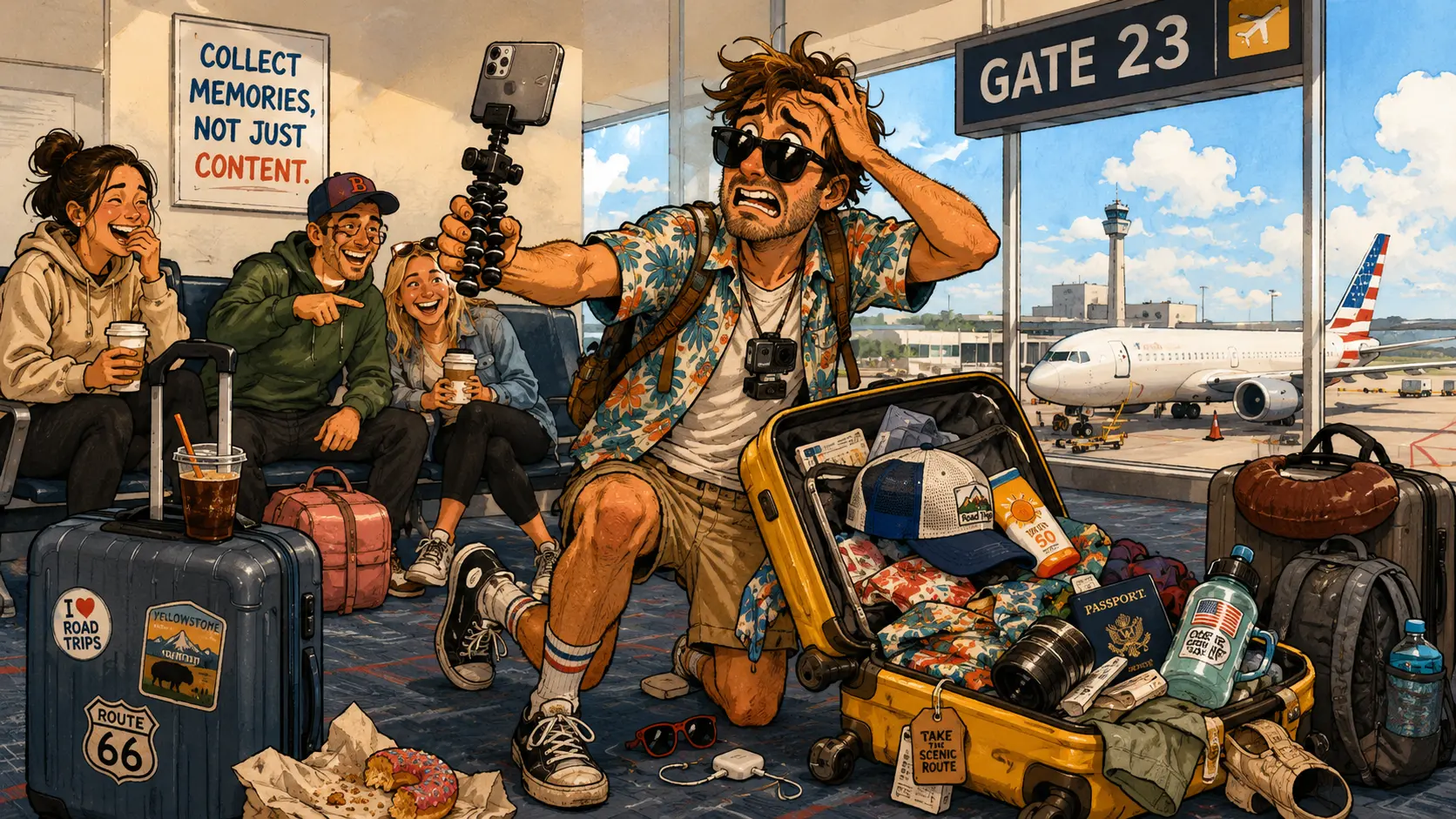
Travel has entered a strange era. You can no longer sip coffee near a nice balcony without somebody whispering, “Wait, hold it again, but laugh naturally.” The laugh is never natural. It sounds like a suitcase zipper begging for mercy.
Still, the creator world has accidentally given regular travelers a useful lesson: a good trip is not just where you go, but how you tell the story afterward. The trick is learning from creator marketing trends without turning your vacation into a low-budget shampoo commercial.
This is a funny travel article for people who want better memories, better photos, and fewer moments where their family quietly considers leaving them at baggage claim.
What This Travel Survival Guide Covers
- Your Vacation Is Not a Brand Deal, Thank Goodness
- The Fast Take Before Your Camera Roll Starts Crying
- Travel Like a Creator, Not Like a Portable Billboard
- The Part Everyone Gets Wrong About Travel Content
- A Saner Way to Capture the Trip
- Final Boarding Call
- FAQs
- References
The Fast Take Before Your Camera Roll Starts Crying
- The argument: Travel like a creator by planning the story of your trip, not by filming every forkful of lunch.
- What people get wrong: They copy the performance, the poses, the dramatic “walking away from camera” shot, but skip the planning.
- Why it matters: A trip can be more memorable when you capture the rhythm, not just proof that you stood near a wall.
- Who should care: Travelers, family trip planners, casual vloggers, and anyone who owns a tripod but still has friends.
- Reality check: The best travel content usually comes from noticing more, not performing more.
Travel Like a Creator, Not Like a Portable Billboard
A June 2026 Think with Google article about creator marketing in Spain made a serious business point: creators are no longer just people who “post.” They can act like production partners, co-create entertainment, mix short and long formats, and build trust that moves audiences from attention to action.
Travelers can borrow the same logic, minus the boardroom vocabulary and the suspiciously enthusiastic “team alignment” meeting. Your trip has a production problem too. Not a Hollywood problem. A human one.
The myths packed in your carry-on
- “If I record everything, I will remember everything.”
- “A good travel photo requires me to block a sidewalk for seven minutes.”
- “The more cinematic the breakfast, the better the trip.”
- “If I did not post it, did the sunset legally happen?”
The creator lesson is not “become content.” The creator lesson is “know what matters before the moment disappears.”
What the creator trend suggests for regular travelers
Creators who understand their audience know the difference between a quick hook and a deeper story. Travelers should learn the same thing.
A quick clip can capture the chaos: the rideshare driver who somehow knows every shortcut except the one you need, the airport snack that cost more than your first phone, the uncle who says he packed light while dragging three bags and a mystery cooler. A longer story can explain what the place felt like: the pace of the morning, the smell of the diner, the roadside stop nobody planned, the beach that looked better after everyone stopped trying to photograph it.
That is the difference between collecting evidence and keeping memories.
The Google piece also highlights trust as a major reason creators work. For travel, trust is the reason your cousin believes your restaurant recommendation even though your last “hidden gem” was a gas station with one heroic breakfast sandwich. Trust comes from showing useful details, not from pretending every trip is perfect.
Mini case: the three-hour boardwalk content spiral
Imagine a family visit to a busy beach boardwalk. The plan is simple: walk around, eat something good, take a few photos, and return before everyone becomes sunburned and financially humbled by parking.
Then somebody says, “Let’s just get one quick shot.” This is how peace ends.
First, the lighting is wrong. Then the sunglasses are wrong. Then a seagull enters the frame with the confidence of a creative director. Twenty minutes later, the group has not moved, the children are negotiating with hunger, and someone’s aunt has started walking away because she understands time better than the rest of us.
A better creator-style plan would be simple: choose three capture moments before the walk begins. One wide street scene, one food detail, one funny human moment. After that, the phone goes down unless something truly worth saving happens. The result is still shareable, but nobody has to sacrifice their personality to the algorithm.
The Part Everyone Gets Wrong About Travel Content
The loudest version of travel content says, “Look at me in this place.” The better version says, “Here is what this place helped me notice.” Big difference.
One turns a destination into a backdrop. The other lets the destination stay alive.
Where the simple take fails
- Pretty is not the same as useful: A perfect beach photo does not tell readers where to park, when the sun gets brutal, or whether the bathroom situation requires courage.
- Viral is not the same as memorable: A seven-second clip can get attention, but your best trip story may be the meal that took two hours because nobody wanted to leave.
- Authentic does not mean messy on purpose: You do not need to film your suitcase exploding on the hotel floor unless the socks have a plot.
What not to do
Do not turn every travel companion into unpaid production staff.
There is a special kind of vacation fatigue that happens when one person appoints themselves “director of memories.” Suddenly, lunch cannot begin because the table needs “texture.” The beach is not relaxing because someone is waiting for “cleaner waves.” A normal walk becomes take 14 of “casually discovering the mural.”
Capture the trip. Do not hold it hostage.
A Saner Way to Capture the Trip
Before you leave, decide what job your phone has. Is it there to help you remember, help someone else plan, entertain your friends, or document a family milestone? Pick one main job. A phone with seven jobs becomes a tiny glowing manager that never approves your vacation request.
For a weekend trip, use a simple 3-2-1 rule:
- 3 useful details: opening hours, price range, parking tip, best arrival time, or what to bring.
- 2 atmosphere moments: a street sound, a funny sign, a local snack, a quiet view, a tiny detail people would miss.
- 1 honest warning: the wait is long, the stairs are rude, the midday heat is not playing, or the “short walk” was written by someone with mountain goat ancestry.
That is enough for a post, a mini-guide, or a family recap. It also leaves room for the wildest luxury in modern travel: actually being there.
Quick reality-check list
- Decide your must-capture moments before the day starts.
- Take the useful photo first, such as the menu, sign, trail marker, or parking area.
- Give yourself a phone-free block of at least 30 minutes.
- Ask companions before filming them, especially during tired, sweaty, snack-deprived moments.
- Keep one imperfect photo. It will probably become the funniest memory.
The creator-style travel framework
| Travel move | Creator-world idea | Better traveler version | What to avoid |
|---|---|---|---|
| Film a quick clip | Short-form hook | Capture one funny or useful moment fast | Repeating it until everyone hates the location |
| Write a recap | Long-form story | Explain what the place felt like and what helped | Making every place sound “magical” |
| Share a recommendation | Trust signal | Include price, timing, crowds, and who it fits | Posting “must visit” with no details |
| Plan a photo stop | Production thinking | Pick one scenic spot and move on | Building a full photo shoot in a public walkway |
Final Boarding Call
The funniest thing about modern travel is that everyone wants “authentic” memories, but many people try to manufacture them like a cereal commercial. Creator trends can help, but only if travelers steal the smart part: planning, storytelling, usefulness, and trust.
Your vacation does not need a content calendar. It needs a little intention, a few good notes, and enough self-control not to narrate every iced coffee.
Take the picture. Make the joke. Save the detail that would help someone else. Then put the phone away before your travel companions form a union.
FAQs
Q1. Is this saying travelers should act like influencers?
A1. No. The point is to borrow the useful habits, such as planning, storytelling, and noticing details, without turning the trip into a performance.
Q2. What is the easiest way to make travel photos more useful?
A2. Take one beauty shot, then take one practical shot. Menus, signs, entrances, parking areas, ferry schedules, and trail markers are often more helpful than another photo of sunglasses near a drink.
Q3. How do I avoid annoying people while filming on vacation?
A3. Ask first, keep clips short, avoid blocking paths, and stop after a few tries. If the moment only works after 19 takes, it may not be a memory anymore. It may be a hostage situation with better lighting.
Q4. Should I post while traveling or after the trip?
A4. For casual travelers, posting after the trip usually feels calmer. You can choose better details, avoid sharing too much in real time, and spend more of the actual trip enjoying the place.
By: Rex Iriarte
Why trust this: This is an editorial travel-humor piece built from a reviewed June 2026 creator marketing trend source, with practical trip-planning examples rather than firsthand destination reporting.
Last updated: 2026-06-30
Disclosure: No paid placement influenced this post.
References
- Think with Google. “El nuevo ‘prime time’: Cómo los creadores redefinen la cultura y el marketing en España.” Harry Walker, June 2026. https://business.google.com/es/think/search-and-video/content-creator-marketing-trends/


0 Comments